
STEVE MARSH
On 12 May 1982 at Dartford, Derek Underwood and Steve Marsh appeared on the Kent first XI team sheet together for the first time. This game against Warwickshire was not Marsh’s first-class debut, as he had played for Kent against Oxford University ten days earlier, but it was his county championship debut. It also turned out to be his only Championship appearance of the summer, as Alan Knott was still firmly in possession of the gloves. In 1983 the situation was the same – Marsh played just once, in an overwhelming defeat against Leicestershire – and in 1984 he only played five times. When Knott was away, Stuart Waterton was preferred behind the stumps as often as not. But when Knott retired at the end of the 1985 season, Marsh was seen as his natural successor, and became a fixture in the Kent side for the next decade and a half. As Leslie Ames wrote in his appreciation of Knotty in the club annual, ‘I am not intending to denigrate Steven Marsh, of whom I have the highest regard, but to follow an artist of Alan Knott’s calibre cannot be an easy task’.
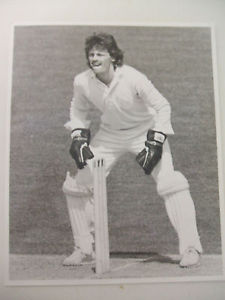
A young Steve Marsh ready for anything
It was not an easy task, but just a quick glimpse at Marsh’s career statistics will show that he deserves his place in the line of Kent’s best wicket-keepers. In 291 first-class games for the county, he made 749 dismissals, a total only beaten by Fred Huish, Alan Knott and Leslie Ames, all of whom played many more matches than Marsh. He still holds the record for most dismissals in an innings, 8 against Middlesex at Lord’s in 1991, a game in which he also scored a century, a double that has never been equalled. When he retired, his place was taken by Paul Nixon, an import from another county, and some saw this at the time as a significant break in the succession of home grown wicket-keepers who had played with such distinction for both Kent and England. Many would say that it was a sad oversight by England’s selectors that Marsh never won an England cap.
What is there in the Kent water that breeds so many wonderful keepers? From Herbert Jenner in the early 1800s through Ned Wenman, Fred Huish, Jack Hubble, Leslie Ames, Hopper Levett, Godfrey Evans, Alan Knott, Steve Marsh, Geraint Jones and Sam Billings, to name but a few, Kent has always had a safe pair of gloves behind the stumps, many of whom batted very well too. And don’t forget Paul Downton and, more recently, Ollie Robinson, two fine keepers capped by Kent who then moved on to more success with other counties.
If we had the answer to that question, then we’d never have to worry, but I expect the answer is as hard to find as the reason why Kent just doesn’t seem to know how to breed fast bowlers. Until about 40 years ago, we had coal mines, but unlike the selectors in Derbyshire or Nottinghamshire, shouting down the mine to find somebody to open the bowling didn’t seem to work south of the Thames. There’s a lot to be said for the role model theory. If young cricketers have a chance to see how much the keeper is at the heart of the game, and how players like Godfrey Evans, Hopper Levett and Steve Marsh were really enjoying themselves and how much they were at the heart of the team in the field, then that may well have encouraged others to try wicket-keeping rather than opening the bowling or batting.
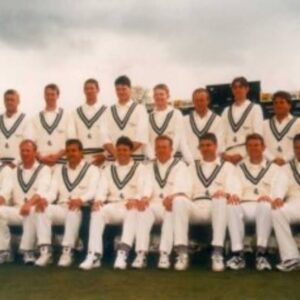
Steve Marsh as Kent captain in 1998
Although Kent came second in the Championship three times during Marsh’s career, we never won the title. In fact, the only piece of silverware Marsh was part of was the 1995 Sunday League title, which Kent just won by virtue of a better run-rate than Warwickshire. Not a particularly good return on a very fine career. During this time, Kent were captained by Chris Tavaré, Chris Cowdrey, Mark Benson and finally Marsh himself, all fine players and good captains, but none were able to win the major prize of the season, the county championship, which still eludes the club, almost half a century since our last title. It has not been because of a shortage of fine players – the likes of Graham Dilley, Terry Alderman, Dean Headley, Martin McCague, Richard Ellison and Alan Igglesden gave our bowling attack a sharp edge, and Carl Hooper was for several seasons a powerhouse in the batting line-up. Add to that list names like Dave Fulton, Matthew Fleming, Mark Ealham and Min Patel and you can see that Kent could put a strong side into the field throughout the 80s and 90s, but it was never quite enough.
In the first game of the 1998 season, Kent gave a first team debut to an 18-year-old Robert Key, who batted for an hour for 18 before dragging a ball onto his stumps. Meanwhile his captain, Steve Marsh, was conceding no byes and made a smart stumping to dismiss Angus Fraser and end the Middlesex first innings. Key would go on to greater things.