
JOE DENLY
The last in our line of fourteen overlapping Kent cricketers over 200 years of top class cricket in the county is one of the most popular among our 21st century players, and one whose career shows us the difference between the solid county pro and the potential Test match winner.

Joe Denly
On 13 September 2006, Kent played Warwickshire at Edgbaston, and chose their prolific second XI opener Joe Denly in preference to David Fulton to make his first team debut and open the batting. He opened with Rob Key, and together they made 56, before Key was out for 25. The 20-year-old Denly, went on to make 86 as the match was petered out into a draw, but that was enough for Denly to be chosen for the next game, the last of the season, against Middlesex at Canterbury. This time he opened with David Fulton, in his final season at Kent, and made a respectable 66. However, with Fulton, Walker and Stevens all making centuries in a total of 603 for 6, Denly was hardly the star. However, it was a promising start.
The years of Denly’s playing career were not particularly successful for the county. There were a few trophies to add to the cabinet – One Day Cup winners in 2022, beating Lancashire at Trent Bridge in the final – and two T20 titles in 2007 and 2021, but there were also too many nearly seasons: Championship runners-up in 2004, One Day Cup runners-up in 2008 and 2018, T20 runners-up in 2008. We also spent 11 of the first 26 seasons of the century in the Second Division, and one, uniquely, in the Third Division, where Kent emerged as champions in the Covid year of 2021 to claim a title which almost certainly will never be taken from them.
Among the players who came into the side in these years, apart from Denly, who went on to play 15 Tests, 16 ODIs and 13 T20 internationals for England, were wicket-keeper Geraint Jones, one of the England team that won the Ashes in 2005, Zak Crawley, who has played more Tests than all but five men in Kent’s history, as well as James Tredwell, Ed Smith, Martin Saggers, Sam Billings and Amjad Khan – Test players all – not to mention overseas signings such as Martin van Jaarsveld, Matt Henry and Brendon Nash. Add to that a number of solid county players, several of whom would not have let England down if they had been chosen, names like Sam Northeast, Darren Stevens, Matt Walker and Daniel Bell-Drummond, and it is easy to imagine we could have won more. However, it seemed that the club was never quite able to put together an eleven who were all fit and on form at the same time, and the overall impression is one of underachievement. We still haven’t been county champions since 1978, almost half a century go.
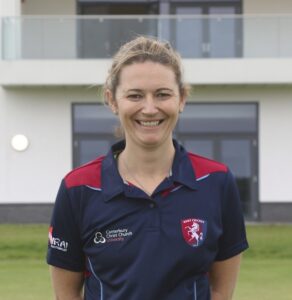
Lottie Edwards
So the men’s county team chugged along, trying to cope with all the changes, some sensible, some ludicrous, which the ECB threw at them, the biggest change came with the growth of women’s cricket. In 1998 the Women’s Cricket Association agreed to merge with the ECB, and this soon gave women’s cricket a much higher profile within the game and with the general public. It also meant that the control of the women’s game within Kent moved from the Kent Cricket Board to the County Club, and with the establishment of an official women’s county championship from 1997, people began to take women’s cricket more seriously. It quickly became clear that Kent, placed in Division One from the outset, were the outstanding team for most of the early years of thec century. Having been runners-up in 2004 and 2005, Kent Women won the championship in 2006 and 2007 and after having been runners-up again in 2008, reclaimed the title in 2009. Between 2004 and 2015, only in 2013 were they not either champions or runners-up. They still won the T20 Championship that year, for the second time, and would do so again in 2016.
The captain of the women’s team, and as history will no doubt show, one of the greatest cricketers to play the women’s game, was Charlotte Edwards, captain of England as well as of Kent, a superb batter and and equally good motivator of a squad of many talents. In 2014 Lottie Edwards became the first woman to be chosen as one of Wisden’s Five Cricketers of the Year, an honour that she now shares with her fellow Kent and England batter, Tammy Beaumont, who was chosen by Wisden in 2019. These two, along with players like Lydia Greenway, Laura Marsh and Tash Farrant were the pillars round which a formidable squad was built, so it was a great disappointment when the ECB once again restructured the women’s game into two tiers, placing Kent in the second, amateur, tier, which precipitated a fully understandable exit by the best players to the professional ranks of Tier One. Still, the women’s game in Kent has certainly caught on with the public, and attendances are consistently growing.
As we reach the end of this random history of Kent cricket, and incidentally the end of Joe Denly’s career as he announced his retirement at the end of the 2026 season, we find Kent cricket in a good place – not a great place, but a good one.
I wonder who will be the next link in the chain. There are plenty of young players in 2026 who may well enjoy a long and successful career with the county. My money is on Ben Dawkins or Ekansh Singh, both of whom have shown impressive potential and both of whom played alongside Joe Denly in his final game for Kent, a 50 over game against Somerset on 31 July which Kent won. We must wait and see.
And at least we will be starting this fifteenth link in Division One.

Kent 2026