
DEREK UNDERWOOD
On 11 May 1963, Kent began their county match against Northamptonshire at Dartford, and for the first time the names of Cowdrey and Derek Underwood were both on the team sheet. This was Underwood’s second game for Kent’s first team, and Cowdrey’s umpteenth, but Cowdrey did not play in Underwood’s debut game, against Yorkshire at Hull three days earlier. The Northants match, despite the presence of these two Kent all-time greats together in the same dressing room for the first time, ended in a draw, despite hundreds from the two left-handers, Peter Richardson and Bob Wilson. Underwood took 2 for 48 and 3 for 13, to add to the five wickets he took at Hull, making an altogether auspicious start to his Kent career. He went on to take 101 wickets for the county in his first season, during which he celebrated his 18th birthday. All the same, the editor of the Kent Annual for 1964 was not overwhelmed: “One swallow does not necessarily make a summer, but it is certainly a most encouraging sign for the future.”
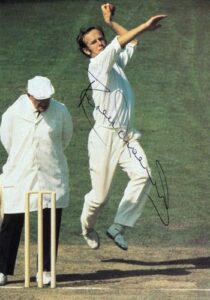
The classic Underwood bowling action
It most certainly was. Underwood, whose bowling style was unique – left arm somewhere around the medium to slow medium mark, with the ability to maintain line and length and to cut the ball enough to defeat the best batsmen – played for the county from 1963 to 1987, and finished with 1951 wickets for the county, third only to Tich Freeman (3340 wickets) and Colin Blythe (2210 wickets). It is a curious fact that all of the top five Kent wicket takers in the club’s history have had as their standard delivery a ball which turns from leg to off to a right handed batsman. Three of these men bowled left handed, Blythe, Underwood and Woolley, and two were right handed leg break bowlers (Freeman and Wright). What that says about Kent wickets, I am not sure. Underwood took 100 wickets in a season for the county seven times, including in three seasons after the reduction in county games in 1969. No other Kent bowler achieved that feat even once. After 1969, ‘Deadly’ took over 50 wickets in a season 15 times. The next most successful in that era is Kevin Jarvis who did it seven times. The importance of Underwood to the Kent team can scarcely be overstated.
His partnership with wicket-keeper Alan Knott, which is now commemorated in the Underwood-Knott Stand at the St. Lawrence ground, was even more effective than the Wright-Evans partnership immediately after World War II, and certainly rivalled the Freeman-Ames combination in the 1920s and 1930s. The fact that some of our greatest bowlers have been backed by some of the game’s greatest keepers is certainly no coincidence. In Kent we have been very lucky to breed such brilliant wicket-keepers, and even luckier to have found the bowlers who can exploit the keepers’ brilliance.
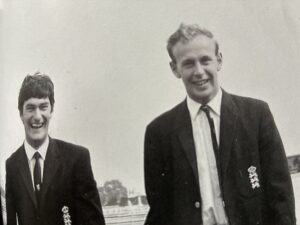
Alan Knott and Deadly in their early days with England
It would be wrong to suggest that the period up to Derek’s retirement were glory years for Kent, but the team was always a threat. The club was astute in its recruitment of overseas players, in the days when you could sign a major Test star for the whole season without worrying about the conflicting demands of T20 competitions around the world. Men like John Shepherd, Asif Iqbal, Bernard Julien and, towards the end of Underwood’s career, Eldine Baptiste and Terry Alderman all contributed mightily to Kent, both on and off the pitch, bringing both skill and experience to the squad.
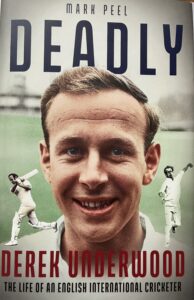
The cover of Mark Peel's excellent recent biography of D.L. Underwood
Deadly always maintained that Hastings was his favourite ground. It is now buried under tons of concrete as a supermarket car park or some such, but when Kent played there against Sussex in 1984, he had a weekend to remember. The county game began disastrously for Kent, all out 92, and by the end of the day Sussex were also all out, for 143, and Kent’s second innings began with Underwood and Lawrie Potter opening as nightwatchmen. The next day they played a John Player League game, which Kent won easily, largely thanks to Deadly’s best ever JPL figures of 6 for 12. The following morning Kent continued their innings, and wickets fell regularly, but Underwood remained unmoved. His third wicket partnership with Chris Tavaré was worth 44, of which Underwood made 41 and Tavaré just 1. But it was not until Terry Alderman joined him at the crease, with Kent 155 for 8, that Deadly was able to hope that he could beat his highest score to date and strike out for a century. Despite being dropped off a very difficult chance on 96, he finally got there and had reached 111 before he was finally out, lbw to Dermot Reeve. Alderman went on to score his own maiden half-century, which left Sussex 193 to win. At 186 for 6, it seemed inevitable that Derek’s batting heroics would not be enough, but Alderman and R4ichard Ellison combined to take four wickets for just 6 runs, and the match was tied. Quite a busy few days for a man in his 22nd season of professional cricket, a maiden hundred, a career-best bowling spell and a very rare tied match. Amazingly, just two weeks later Kent played another tied match, away against Northamptonshire. Underwood played in this game too, but did not bat, and hardly bowled.
After his retirement, Derek remained active within the game. He did a great deal for the Primary Club, the charity that seeks to help blind and partially-sighted people get involved in cricket, and in 2006, he was made President of Kent CCC. In 2009 he was appointed President of MCC, nominated by Mike Brearley who liked and respected him greatly. His final years were blighted by dementia but he was always the kindest, friendliest and most modest of men, until he stepped over the boundary ropes. Then he was Deadly.