
9. Doug Wright
On 10th May 1933, at the Ashley Down Ground in Bristol, Frank Woolley and Doug Wright stepped out onto the pitch together as Kent players for the first time. Douglas Vivian Parson Wright was an 18-year-old leg spinner no doubt in awe of the Kent legend who was now his team-mate. Wright batted for Kent against Gloucestershire at number 11, even below Tich Freeman, the leg spinner who set all the bowling records that Woolley – and later Wright himself – couldn’t quite beat, and had a chance to bowl at the great Walter Hammond. But it was Freeman who took 8 for 48 in Gloucestershire’s first innings, while Wright took 2 for 30, and in a very close match, Kent lost by only 8 runs (Wright not out 0 as the final wicket fell). Woolley had a quiet game, 30 runs in all, no catches and did not bowl. But the baton was passed on to the next man in the chain of Kent cricketers.
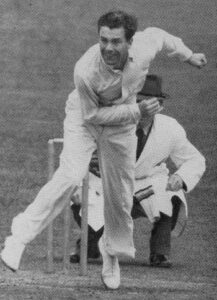
Always an attacking bowler, as his record 7 hat-tricks show
Between 1932 (one game v Warwickshire in July that year, no runs, no wickets) and 1957, Doug Wright played 397 games for Kent, and took 1709 wickets with his slippery leg-spin, a tally which puts him fourth on the all-time list, behind Freeman, Blythe and Underwood. He took 100 wickets in a season nine times, and still holds the world record for most first-class hat-tricks, 7. He took two wickets in successive balls a further 15 times! He was also a useful tail-end batsman, scoring 5074 runs with 15 fifties but no hundreds, and snaffling 152 catches for the county. His lasting place in Kent’s history is assured, though, by his being appointed the club’s first ever professional captain, in 1953, after the unceremonious sacking of his amateur predecessor, Bill Murray Wood.
Doug Wright was born in Sidcup on 21st August 1914, just seven weeks after the assassination of Archduke Franz Ferdinand precipitated the outbreak of World War I. Three of the great Kent wicket-takers, Frank Woolley, Colin Blythe and Percy ‘Tich’ Freeman, were playing for the county that year, but as it turned out, Blythe’s last game began when Wright was five days old. Within nineteen years, however, Wright was in the same team as Freeman and Woolley and eventually earned his place alongside them as one of Kent’s greatest players.
Like many great bowlers, Wright’s action was hard to classify. Yes, he bowled leg-spin, but at a speed that was usually described as medium pace, and with a quicker ball that probably touched 80 miles per hour. He had a run-up which bore some resemblance to Jasprit Bumrah’s approach to the wicket in modern times. It never seemed to be as rhythmical as it ought to have been, but for Wright, it worked. Although in 34 Tests, he took 108 wickets at an average of almost 40 (compared with 1709 at 22.68 in all matches for Kent), no batsman ever felt at ease facing his unique style of leg-spin. John Arlott wrote about him that “to bowl a length with a fully finger-spun leg-break as distinct from the rolled leg-break is difficult, to bowl a leg-break really fast is impossible for everyone who ever played cricket, except Doug Wright”.

Wright, playing for England post-war, is presented to HM King George VI
The 1930s were not bad years for Kent cricket. The club came third in the Championship in three consecutive years from 1931 to 1933, but as the decade wore on, they came to rely on Woolley, Freeman and Ames more and more. In 1937 they slipped to12th, their lowest placing for forty years. In 1933, for example, they finished third, but as Wisden pointed out, “Kent never got into the running for the Championship.” The lack of any bowler to back up the phenomenon that was Tich Freeman was an issue throughout the decade, and although Wright did his best, he was another leg-break bowler and there was no reliable opening bowling partnership for many years. Wisden added, “Had illness or accident deprived Kent of the services of the veteran slow bowler the side would have found themselves in queer street.” That year, Freeman took 252 wickets for Kent, while all the other bowlers combined took just 202 of which Wright took 23 in 12 matches. It weas not helped by the fact that from 1931 to 1937, Kent appointed Percy Chapman as the county captain, but also appointed a deputy captain each year. In 1936, they appointed two deputy captains to take over when Chapman was unwell, or otherwise unavailable as he often was.
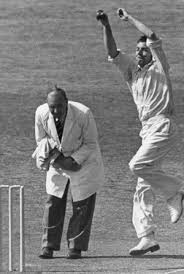
His distinctive bowling action was immediately recognisable
The post-war years were even worse for Kent. Between 1948 and 1963, the county only finished in the top ten three times. But in the early 1950s, the dominance of the amateur captains was finally broken. Ted Dollery, a professional, had led Warwickshire to the title in 1951, and Len Hutton, another professional was proving a very successful captain of England, so the Kent committee, never the most progressive body in the land, bit the bullet and dramatically fired Bill Murray-Wood (amateur) mid-season in 1953, and appointed Doug Wright (professional) in his place.
It would be wrong to suggest that Wright’s appointment immediately changed things for the better, but the die was cast and the status of professionals at the club was enhanced for good. His three years in charge were not successful on the field, although Wright himself took 12 wickets against Somerset in his first game as official captain, and at the end of 1956, he stood down and handed the captaincy on to Colin Cowdrey, an amateur.
In his retirement, Wright became a very fine coach, still firing in his leg-breaks at unsuspecting wannabe batsmen well into his 60s, and when he died in 1998, aged 84, Kent had lost a very great cricketer and a very fine man.
0 Comments