
Frank Woolley
Frank Woolley is generally regarded as Kent’s greatest all-round cricketer and certainly statistically there is nobody to touch him, except possibly WG Grace. His first game for Kent, however, did not create great expectations in the eyes of the crowd watching. That was against Lancashire at Old Trafford on 7th, 8th and 9th June 1906. With Fred Huish keeping wicket, Woolley opened the bowling with Arthur Fielder, and eventually took 1 wicket for 103 runs as Lancashire rattled up 531, with Johnny Tyldesley making 295 not out, still the highest individual score ever made against Kent in the Championship. Wisden described his first match as ‘disastrous’, for apart from his less than penetrative bowling, he dropped three catches off Tyldesley, and made a third-ball duck in his first first-class innings. And Kent lost by ten wickets. However, from there his career went on an upward curve that never really faltered.
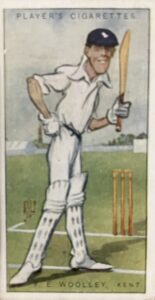 Woolley was born on 27th May 1887 in Tonbridge. There is still a blue plaque on the wall of the Starbuck’s in Tonbridge High Street marking his place of birth. In 1887, it was not a Starbuck’s, of course – it was the family home from where his father ran his bicycle and engineering business. Tonbridge was the right place to be born if you had cricketing ambitions at that time, because the Tonbridge Nursery, overseen by Captain McCanlis, was quickly becoming the best cricket academy (indeed, almost the only cricket academy) in the country. By the time he was 14, he had been spotted by the Kent general manager Tom Pawley, who recommended him to McCanlis, and that signalled the end of Woolley’s schooldays and the beginning of his remarkable cricket career.
Woolley was a tall man, over six feet, and batted and bowled left-handed. His statistics (47,868 runs, 122 centuries, 1680 wickets and 773 catches in 764 games for Kent) are far and away the best of any Kent player in history, but the numbers were not the reason why people flocked to see him play. His grace, power and style as a batsman were why he was such a draw. If you wanted to see batting at its most perfect, you just had to watch Frank Woolley in full flow. Neville Cardus, never the most prosaic of cricket writers, wrote that “one thinks of him as a butterfly in a city street on a summer’s day”, which makes little sense, but Ian Peebles, the Middlesex and England leg-spinner was clearer, describing Woolley as “the most graceful of the efficient, and the most efficient of the graceful.” Raymond Robertson-Glasgow known throughout the cricket world as ‘Crusoe’, said that “when you bowled to him, there weren’t enough fielders; when you wrote about him, there weren’t enough words.” For 30 years he was the heart of the Kent eleven, and for most of those years, he was the heart of the England eleven as well.
In his first season, Kent won the county championship for the very first time. The two things are connected, but it would be wrong to suggest that Kent would not have been champions if Woolley had not made his debut until 1907. The Kent team of 1906 was a great side, and though it is possible in retrospect to state with confidence that Woolley proved to be the greatest of them all, in his first season he was merely very promising, and was sometimes left out of the side to allow one of the county’s many highly talented amateurs to play. He is not, for example, featured in the famous “Kent v Lancashire 1906” painting, because he was dropped for that game, which Kent won in a canter. His debut only came about because Colin Blythe, an even greater left arm bowler than Woolley, was injured, but over the next nine seasons, the two great left-handers regularly played together.
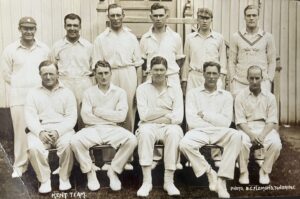
Kent in 1931. Woolley seated 2nd from right, next to captain Percy Chapman. Tich Freeman is on Woolley’s left
Thanks to the efforts of Lord Harris, Tom Pawley the club manager and a brilliant organiser, and Captain McCanlis’ Tonbridge Nursery, Kent became the only county who could stand toe to toe with Yorkshire in those final pre-war years. They were champions four times in those years. Although there was a stream of very fine amateur batsmen in this period, men like ‘Pinky’ Burnup, Ted Dillon, the Day brothers, Kenneth Hutchings, ‘Slug’ Marsham and Jack Mason, it was the solid core of professionals, most of whom came through the Tonbridge Nursery, that held the team together and kept it at the top of the table. Men like ‘Punter’ Humphreys, James Seymour, Fred Huish, Arthur Fielder, Bill Fairservice, Colin Blythe and Woolley himself were the secret to Kent’s continuing success.
For the best part of a decade, Kent remained a powerhouse, but the outbreak of World War I in 1914 marked not only the end of cricket for four years, but also the end of the county’s dominance. There was no obvious reason for this. Colin Blythe and Kenneth Hutchings had both been killed in the war, but both Hutchings had retired in 1912, and Blythe had said he would not be playing after the war. In fact, the eleven for the first championship match after the war contained seven men who had played in the last one before the war (all nearly five years older, of course) and only one member of the side, the Oxford Blue Eric Bickmore, was making his debut for the county in that game. But as the side aged, their replacements proved to be mostly not quite as good.
There were exceptions, of course. Tich Freeman, who played a few matches before the war, proved to be the most prolific wicket taker of the 1920s and 1930s, and is second only to Wilfred Rhodes of Yorkshire in his all time tally. Replacing Fred Huish proved to be difficult, but in 1926 Leslie Ames made his debut, a man who would prove to be the second in the line of truly great wicket-keepers, and strengthened both the keeping and the batting for over two decades. The bowling was more problematical. Freeman was a wonder, and Woolley wheeled away untiringly (he took 5 for 59 against Essex on his 50th birthday in 1937), but the fast bowling was a problem. After Arthur Fielder retired, Kent failed to find a truly penetrative opening bowler, let alone an opening pair of quick bowlers, for many years. This is a situation that has not changed over the decades. While Derbyshire and Nottinghamshire could just whistle down a coalpit and up would come a handful of opening bowlers, Kent have always struggled to find home grown fast bowlers. There seems to be no particular reason why.
Between the wars, Kent never won the County Championship, although they were rarely out of the top five, coming second in 1919 and 1928 and third in four other inter-war years. The county was always considered one of the strongest, but somehow, after their golden years before 1914, the years of Woolley’s youthful brilliance, they never finished the season on top of the pile.
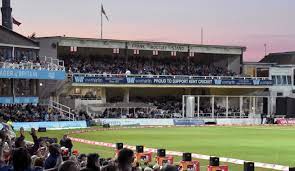
The Woolley Stand
When Woolley retired, aged 51, at the end of the 1938 season, he had broken almost every batting and fielding record and was very highly ranked on the bowling lists. Most of his records still stand, and some, such as his 122 centuries for Kent or his 27 seasons of scoring over 1000 runs for the county, will never be beaten, but his record for the highest score ever made by a Kent player at Canterbury (270) only lasted until 1996 when Matt Walker scored 275 not out against Somerset. It is reported that E.W. ‘Jim’ Swanton, a lifelong admirer of Frank Woolley, pleaded with Trevor Ward, Kent’s captain in the Somerset match, to declare before Walker beat Woolley’s record, but Ward was never to be deflected from the needs of the team. He did declare before Walker could complete a triple-century, but Woolley’s record bit the dust. Not that the great Frank Edward Woolley, who died in 1978, would have cared. Statistics never particularly bothered him.
The Woolley Stand at Canterbury, was built in 1927 and romantically named The Concrete Stand. It was one of the largest cantilever structures in the world when it was built, and is now one of the oldest concrete structures still standing in the UK. It was renamed in honour of Woolley in 1973, and its upper section is still considered to provide the best viewing position on the ground. The view was always best when the great Frank Woolley was batting.
0 Comments