
Ned Willsher
On 11th and 12th July 1850, Surrey played Kent at the Kennington Oval, and for the first time Alfred Mynn and Edgar Willsher played together for Kent. Fuller Pilch was also playing for Kent, but despite the presence of these three major names in the history of Victorian cricket in Kent, Surrey won easily, by an innings and 110 runs. None of our three disgraced themselves – indeed Willsher took 4 wickets and made a catch in Surrey’s innings, while Pilch and Mynn both made one decent score out of their two innings, but as seems to be the case when one great name hands the baton over to another Kent legend, the match in which this happens rarely goes well for Kent. Over the next four years, Willsher and Mynn played together for Kent a number of times, but their last appearance together for Kent – which was also Fuller Pilch’s final first-class match – in August 1854, resulted in another defeat for Kent, at the hands of England, a match played as part of Canterbury Cricket Week that year.
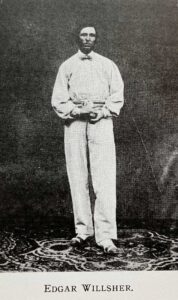
Edgar Willsher (known as Ned) was born, apparently with only one lung, on 22nd November 1828 in Rolvenden. He was the youngest of his farmer parents’ fourteen children, and was only 21 years old when his long career as a Kent player began. He was a left handed batsman and bowler, and although his batting was not particularly outstanding, his contemporaries were fulsome in their praise of his bowling. He still ranks 16th in the list of Kent’s all-time wicket-takers, and in the opinion of Lord Harris, who only played with him when Willsher was past his best, described him as ‘one of the finest cricketers Kent ever produced’. The Nottinghamshire batsman Richard Daft (1835-1900) wrote that of the three great bowlers of the Victorian era – Willsher, JC Shaw and Alfred Mynn – “at his very best I believe Willsher was the best of the trio. He was faster, and his ball got up more than those of the other two”.
In comparison with modern day fast bowlers, he was probably slower, probably around Underwood pace, but imagine Derek Underwood on similarly underprepared wickets – a batter’s nightmare. What is more, is this era of round arm bowling, when raising the arm above shoulder height was illegal, Willsher was one of the bowlers who tested this law to its limits with his action, described by Daft as “rather a peculiar one…..I believe that when the ball left his hand it was exactly on a level with his shoulder. He came up to the wicket with a quick-march kind of step, raised his hand high above his head, bringing it down, however, with a very quick jerky movement just as he delivered”. Clearly there were many who felt that his action was not always within the law as it stood. So just as John Willes had fought for round-arm rather than underarm bowling, now Willsher, 40 years later, was in the thick of the fight to legalise overarm bowling.
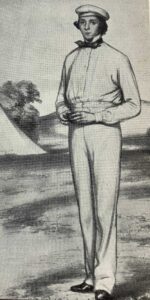
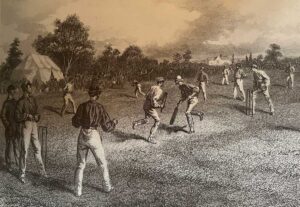
John Willes, George Knight and others had won the fight to legalise round-arm bowling, but very quickly bowlers who tried this form of delivery realised that raising the arm higher than the shoulder was an even more effective of bowling. Several leading cricketers, notably William Lillywhite, were pretty flagrant in their breaching of this law, as well as Willsher, who largely got away with it, until a plan was concocted to force the issue. Willsher was picked to play for an England team against Surrey at the Oval in August 1862. One of the umpires was John Lillywhite, the son of William and a personal friend of Willsher. The events that followed were melodramatic and almost certainly carefully planned. England batted first, and compiled a total of 503 (Willsher 54) over the first day and a half. When Surrey batted, Willsher opened the bowling with his captain Vyell Walker. Umpire Lillywhite looked carefully at Willsher’s action, and gave him several warnings, until in the third over, he no-balled Willsher six times. Willsher threw down the ball and mimicking John Willes, strode from the field, taking most of the team with him. There was no more play that day, and the complete England team took the field the next morning, but John Lillywhite did not. He was replaced by another umpire for the remainder of the match, and it was agreed that Willsher should be allowed to bowl in his usual style. He did, taking 6 for49 as Surrey were bundled out for 102. The match ended as a draw, but the newspapers at the time were unequivocal in their indecisiveness “Rule 10 must either be altered or enforced”. But they also took time to call Willsher “as fine a cricketer and as good a fellow as ever handled a bat or trolled a ball”. Two years later, all restrictions on the height of the arm at delivery were abolished.
During Willsher’s long stay in the Kent eleven, there were other big changes. In 1859, largely because of the continuing shaky finances of Canterbury Cricket Week, a new Kent County Cricket Club was formed. It was felt that the committee in charge of Canterbury Week were not interested in the cricket, but only in the festivities in the city, and the secretary, William de Chair Baker, was a difficult man. Baker fought hard not to have his authority taken away from him, but at a meeting in Maidstone on 1st March that year, the club was formed, with Lord Darnley as President, and W South Norton and Lord North as joint secretaries (all points covered, you might say). William de Chair Baker and his Beverley Club remained in charge of Canterbury Week, but the new club had control of the other Kent matches. For a while, they imagined this state of affairs could work, and the shortage of money persisted. From the mid-1860s onwards, there was new pressure to unite the two clubs, but de Chair Baker always refused. Finally, at a meeting of the committee of the Kent County Cricket Club, it was resolved that ‘this meeting is of the same opinion with regard to amalgamation with the Beverley Club as that expressed in a report issued in 1865’, which Baker had turned down flat. Rather than try a formal approach to the Beverley Club, it was decided to use the diplomatic skills of Herbert Knatchbull-Hugessen, a keen cricket supporter from a wealthy Kent family based at Mersham, near Ashford, and thus it was that the Beverley men were persuaded to attend a meeting held on 6 December 1870 at the Bull Hotel in Rochester. It was significant that Rochester was just on the right side of the Medway to be in East Kent, part of the Beverley Club’s sphere of cricketing influence, and when the motion for the amalgamation of the two clubs was proposed, to the relief of all, it was finally passed. It is this date that the current Kent County Cricket Club claims as its foundation.
 As Ned Willsher’s cricket career was coming to an end, big changes were taking place in cricket. Several counties created their own cricket clubs around this time, and from 1864, an unofficial but nevertheless well noticed method of ranking the county clubs was developed, so that a Champion County for the summer was able to be nominated. Kent, so long a powerhouse of cricket, was never Champion.
In retrospect one of the biggest developments in English cricket was the publication of the first Wisden Cricketer’s Almanack in 1864, at the time perhaps only one of several cricket annuals on the market, but soon to become the unofficial voice of the cricket establishment, with increasing influence over the way the game was played. In the same year, overarm bowling was finally legalised and WG Grace made his first-class debut. As cricket became more popular around the world, Willsher was not to be left out. In 1868 he captained an England team that visited the United States and Canada, playing 6 matches against odds. The Englishmen won 5 and drew one of the matches. How things had changed since Willsher’s debut in 1850.
In July 1871, MCC staged a “Married vs. Single” for Willsher’s benefit, a sign of how highly he was regarded by the whole cricket establishment. The Single Men won by an innings, largely thanks to a century from their opening bat, one WG Grace, and the benefit raised £73/9/- (£73.45 in new money) for Willsher, a tidy sum in those days.
On 29th, 30th and 31st July 1872, Kent played Sussex at the Angel Ground, Tonbridge. For the first time, Willsher and George Canning Harris, the future Lord High Everything of Kent cricket, played together in a Kent side. Despite Ned Willsher’s magnificent all-round performance, nine for 151 in the match, as well as 53 runs undefeated, Kent lost by 148 runs. Harris scored 8 and 13. Once again, the handing over of the baton from one Kent player to the next in the chain was not combined with success on the pitch. Maybe we should concentrate more on the last time they played together for Kent, against Hampshire at Catford on 17th and 18th June 1875, a game that Kent won by an innings and 3 runs. Harris scored 92, and Willsher took 5 for 45 across the two innings, including the final wicket to win the match. A fitting end to a wonderful career.
Willsher died on 7th October 1885, in Lewisham, aged 56, always remembered as one of the greatest of all cricketers of the mid-Victorian golden age of Kent cricket.
0 Comments