Colin Cowdrey
On 19 August 1950, a 17-year-old batter, who also bowled a bit of leg-spin, made his debut for Kent, against Derbyshire at the County Ground in Derby. Although Derbyshire easily won the game, by an innings and 95 runs, Wisden noted that “Cowdrey, the Tonbridge School captain, made a promising debut.” Doug Wright was also playing in that game, but the captain that time was Leslie Ames, Kent’s great wicket-keeper/batter, who was, incidentally, a professional. The next link in the chain of Kent players was thus forged, as was the beginning of the partnership between Ames as manager and Cowdrey as captain, which led to Kent’s greatest period of sustained success in the late 1960s and 1970s.
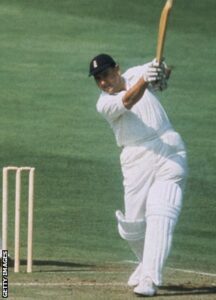
Colin Cowdrey in full flow
Cowdrey made 15 and 26 on his introduction to county cricket, and also took one wicket for 37 runs. The very next match was the return game against Derby, played at Dover, when Kent avenged their defeat at Derby by winning by nine wickets. Cowdrey scored 4 and did not take a wicket in the two overs he bowled. Wright, on the other hand, took 10 for 97 in the match.
Michael Colin Cowdrey was born on Christmas Eve 1932 in Ootacamund, about 100 miles north of Bangalore (now Bangaluru) in India, where his father was a cricket obsessed tea-planter. Legend has it that his father gave his son the names Michael Colin so that his initials would be MCC, a club for which his father put him down at birth, but Cowdrey himself said he did not know if that was true as he never discussed it with his father.
Cowdrey no doubt qualified for Kent by birth, as Kent was the nearest first-class county to Ootacamund, but he soon qualified by residence as well, being sent to boarding school at Tonbridge, having before that been sent to prep school in Surrey from the age of 5. Imagine if he had decided to play for Surrey rather than Kent!
At Tonbridge he caused a sensation by being picked for the school’s first XI when still only 13 years old, but he justified his selection by his efforts on the field, especially his leg break bowling which at this stage in his career was exceptional. His child prodigy reputation led Kent to take a close interest in this young man, who as he grew taller, improved his batting at the expense of his bowling, a fate that befell other fine schoolboy cricketers, including Michael Atherton and Nasser Hussain. Cowdrey was invited to play a few games for Kent Young Amateurs in the school summer holidays, and by scoring over 320 runs in three innings for KYA, he was firmly fixed on Kent’s radar. It would almost be unnecessary to recount all the successes of a career that makes Cowdrey perhaps the greatest batsman ever to play for Kent, but it worth noting that in his playing career from 1950 to 1976 he scored 23,779 runs for Kent at an average of 42.01, and hit 58 centuries. In all first-class cricket he scored 42,719 runs at 42.89, hit 107 hundreds, and also took 65 wickets at over 51 apiece. He was also a truly wonderful slip fielder with lightning reactions surprising in a man who was not passed as fit for National Service because of his flat feet! The figures show that he played almost as often for other teams as for Kent, including 118 Tests for England, but his contribution to Kent cricket was not limited to his on-field efforts.
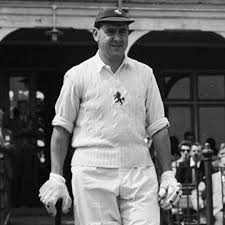
Walking out to bat for Kent
After a succession of poor results in the first decade after the war, the Kent committee appointed Cowdrey to be captain for 1957. He was only 24 at the time, but already an established England cricketer and a popular member of the Keent side. At the same time, David Clark, then chairing the Cricket Committee, appointed Leslie Ames as manager, a new and revolutionary appointment, which proved to be a master stroke. The club showed something that so few professional sports clubs know much about – patience. They did not expect overnight success, which was fortunate, because they did not get it. From 1957 to 1963, Kent only once finished in the top half of the Championship table, but slowly a powerful squad was being put together. You could argue that the abolition of the distinction between amateurs and professionals at the end of the 1962 season, and the introduction of the Gillette Cup, the first limited overs competition, in 1963, acted as a spur to Kent’s ambition, but there was more to it than that. The 1963 Kent Annual shows that some of the future stalwarts of our glory years of the 1970s were beginning to assemble – Denness, Knott, Luckhurst and Nicholls are all already on the staff, and several reliable senior men, like Brown, Dixon, Leary, Richardson and Wilson are still going strong. In 1964 the name of Underwood first appeared. In the 1964 Annual, the editor noted that “the success of the younger players… suggests a happier prospect for the future”. He was right.
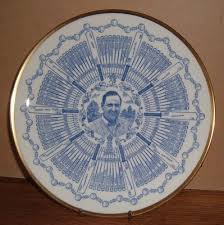
The presentation plate commemorating Cowdrey’s one hundred hundreds
In 1964, Kent finished in the top half of the championship table, where they stayed every year of Cowdrey’s remaining captaincy, with one blip in 1969, when they slipped to 10th, in a season when they were often without Knott, Underwood and John Shepherd – touring with the West Indies – on Test duty, and Cowdrey who ruptured his Achilles tendon early in the season and only played four games in the Championship. Kent did however win the Second XI championship title that year, and in 1970, Cowdrey’s penultimate season as captain, they won the Championship title for the first time since 1913. The glory years of the 1970s were underway. Between 1967 and 1978, Kent were county champions three times, runners-up three times, one-day cup winners twice and runners-up once, Sunday League winners three times and runners-up twice, and Benson and Hedges Cup winners three times and runners-up once. They also won the Second XI title three times. They could field a team containing no fewer than eight players who had scored Test hundreds, who, along with Knott and Underwood, two of Kent’s greatest ever cricketers, made up a formidable opposition for any county.
The driving force behind all this success was the team of Leslie Ames and Colin Cowdrey. In 1975 Colin Cowdrey announced that it would be his last season of first class cricket. That summer he was responsible for Kent’s first victory against the Australians in more than 75 years. Accepting the challenge of scoring 354 in the fourth innings at more than a run a minute, he finished on 151 not out, a knock described in the 1976 Annual as “an impeccable and chanceless display of batting which will long be remembered…. Those who were so fortunate to be at Canterbury that day will perhaps see it as a summing up of all that had gone before.”
In his retirement from playing, he became a distinguished administrator, was appointed President of MCC, received a knighthood and eventually became Baron Cowdrey of Tonbridge. He was serving as President of Kent CCC when he died in 2000, at the age of only 67. Kent lost one of its greatest ever cricketer, and one of its most charming gentlemen.
0 Comments