
FRED HUISH
On 17, 18 and 19 August 1896, Kent played Gloucestershire at Cheltenham College, a match which Kent finished as winners by 25 runs. This game marked the first time that the 45-year-old Lord Harris had played for Kent in a county championship match, as the championship had only been officially established in 1890, and Lord Harris had been governing Bombay from then until 1895. It also marked the first time that Harris played alongside the first in the line of Kent’s great wicketkeepers of the overarm era – Fred Huish. So the baton was passed on.
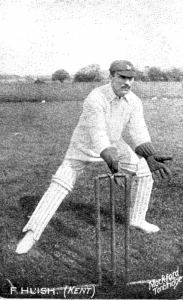 Frederick Henry Huish was born on 15 November 1869, and made his debut for Kent in 1895. His first match was against Warwickshire at Edgbaston, but soon thereafter he broke his collar-bone and was unavailable for most of the rest of the season. This was very unfortunate for Kent, who had a disastrous season in 1895, finishing rock bottom of the championship table, and who had to make the best of a group of inexperienced wicket-keepers to fill the hole that Huish had been expected to fill. In 1895, Kent used seven other wicket-keepers besides Huish, none of whom were really up to the job, so when 1896 dawned, a fully fit Huish quickly established his place in the Kent eleven. As Wisden noted, “One very satisfactory feature of Kent cricket… was the consistent form shown in wicket-keeping by the young professional F.H.Huish”. The writer added, “Huish has youth on his side… and there is every prospect of his… remaining for several seasons to come the regular wicket keeper of the Kent eleven”. A very accurate prediction – Huish remained the county’s first choice keeper until the onset of war in 1914. All in all he played 469 matches for Kent, taking 902 catches and stumping 352 more victims. Only six players have turned out more often for the county than Huish, and his total of 1254 victims is 239 more than the next man, Alan Knott. In 1911, he became the first man to claim 100 victims in a season. His batting was never his strength, but this was in an age when wicket-keepers often batted at number 10 or 11, and his career average of 12.84 for Kent, including twelve half centuries, showed he was not a complete rabbit. Derek Carlaw, in his monumental A to Z of Kent Cricketers, describes Huish as ‘a competent late-order batsman’, which in his era he was, but today he would definitely be considered a tail-ender.
Huish proved to be one of the key components in the rise of the Kent eleven in the early years of the twentieth century. Between his debut in 1895 and his last match in 1914, Kent were county champions four times (in 1906, 1909, 1910 and 1913), with a team built round a group of very talented amateur batsmen and a central core of brilliant professionals, including Colin Blythe, Frank Woolley, James Seymour, Wally Hardinge and, by no means least, Fred Huish.
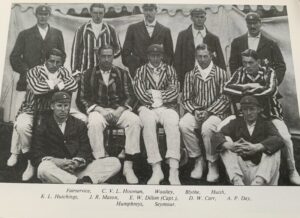 Two decisions taken by the Kent CCC committee at the start of Huish’s playing years made a huge difference to the county’s fortunes. In 1896, the club bought the St Lawrence ground from Lord Sondes, who had been a generous landlord, but the change of ownership meant that the club could now develop the ground and its buildings, as well as having a true home ground, with all the security that brought with it. The Ladies’ Enclosure (where the Ames Stand is now) was built in 1897 and the pavilion in 1900 and the annexe in 1909. All have been significantly redeveloped since then, but the St Lawrence ground began to take modern shape at this time.
 The other decision which had a huge impact on the club’s on field success was the establishment in 1897 of the Tonbridge Nursery, where Capt William McCanlis was the coach and mentor to many players who graduated from what was essentially Kent’s first cricket academy into the first team. Although Huish himself slightly predated the Nursery, there were many other great names – Woolley, Blythe, Seymour, Fielder and Freeman among a host of others – who came through Capt. McCanlis’ regime and into Kent’s great elevens.
Fred Huish played for Kent until 1914, when the war ended his career at the age of 44. But he was scarcely more than halfway through his long stint behind the stumps for Kent when he first played with the next link in the chain, Frank Woolley. At Old Trafford against Lancashire on 7th, 8th and 9th June 1906, the Kent scorecard featured both Huish and Woolley for the first time. Woolley did not start strongly.
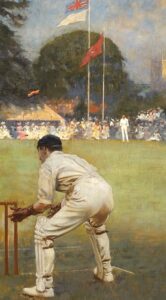
Fred Huish, Kent’s unofficial senior professional for many seasons, whose backside features prominently on the Chevallier Tayler painting “Kent v Lancashire 1906”, lived a long and happy life, dying in 1957 at the age of 87. Described by Wisden as “one of the ablest and least demonstrative wicket-keepers of his generation”, it was said that his influence over his fellow professionals was such that, unless he appealed, no other professional dared appeal for a catch at the wicket. Times have certainly changed in that respect.