
LORD HARRIS
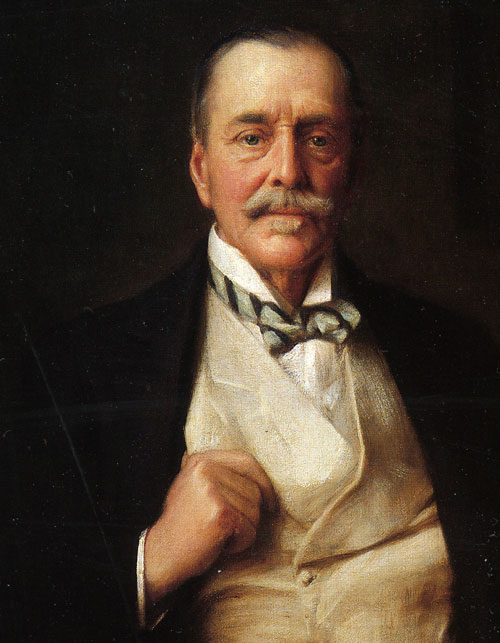
What should one say about George Canning Harris, the man who was Kent cricket from his appointment to the committee of the newly formed Kent County Cricket Club in December 1870 until his death in 1932? No person has ever exerted such authority over such a long time over a county club, with the possible exception of his friend Lord Hawke in Yorkshire.
Harris was born on 3rd February 1851 in Trinidad, where his father was serving as Governor. Of aristocratic blood and very conscious of the status and responsibilities that went with it, Harris built his life around the twin pillars of his philosophy, paternalistic duty and Kent cricket. After school at Eton, he went up to Christ Church, Oxford, where he studied sufficiently to be awarded his degree at the end of three years, and played cricket. We should say at this point that Harris was not merely a well-born cricket enthusiast, who captained the county side because he was the most available amateur: Harris was a seriously good cricketer. It would be hard to put him on the level of Kent’s greatest batsmen, but he was good enough to play four times for England, and to end his Kent career with a batting average of 30 – very good for his era.
His influence over all cricket, not just cricket in Kent can be shown by the fact that he was variously captain, chairman, hon secretary, president and chairman of the young players’ committee, and held at least one of those positions every year from 1870, when the club was formed, until his death in 1932. He was also a member of the MCC committee from 1875 – 1889, President of the club in 1895, and a trustee for 45 years and treasurer for 35. Her also found time to serve as Governor of Bombay (now Mumbai) from 1890 until 1895, and did a great deal to promote cricket on the subcontinent while he was there.
Cricket in 1872, when Harris becomes our Kentish flag-bearer, was changing rapidly. Much of the change was brought about by the brilliance of WG Grace, who was then 24 years old and in his physical prime. His technical skills forced opponents to find ways of coping with his run-scoring brilliance, or at least try to copy it, but that was easier said than done. Nobody has ever dominated his cricketing age as much as WG did, with the possible exception of Don Bradman, but he didn’t bowl.
In Kent, however, it was a time when the greats of Willsher’s era had retired, and those who took their place were generally not of the same quality. The establishment of the Kent County Cricket Club, however, was beginning to prove a good idea. Harris had only one aim throughout his life, and that was to make Kent the top cricketing county, and although it would be fair to say that Yorkshire probably took the overall title in Harris’s time, Kent had some brilliant players and wonderful seasons, largely guided by Harris and his policies.
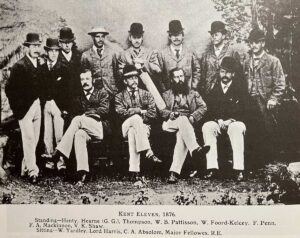
In those early days of the county club, there was still some friction between the remnants of the two clubs which had been amalgamated. Canterbury Week was the only part of the season managed by those based at St. Lawrence, while all other games were managed by the former Beverley Club and played around the county at what we would now call outgrounds, but at the time had equal status with Canterbury. One of the big problems that Kent faced was the difficulty of persuading the county’s many talented amateurs to commit regularly to playing for the county. They preferred the play country house cricket at weekends, and then come along to enjoy Canterbury for the Week, which made creating a consistent team very difficult.
Lord Harris had the huge advantage of a natural authority and a kind nature behind an often irascible appearance, so he proved very good at getting people to do what he wanted. Selection began to become more consistent as even the louchest amateurs wanted to play for Lord Harris. But to support his amateur batsman, he needed a backbone of professional players. The days of rich landowners employing cricketers as ‘gardeners’ or ‘estate managers’ were long gone, so the employer had to be Kent CCC and money was short.
Perhaps Harris’ greatest achievement for the county, therefore, was to persuade the many talented amateurs to play regularly for the county side rather than for one of the county’s many wandering weekend sides, while at the same time building a club which was financially viable, and able to recruit, train and pay professionals a fair wage. He gave the county side a consistency it had previously lacked, and he built on that consistency to create an increasingly hard to beat team.
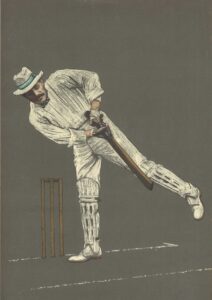
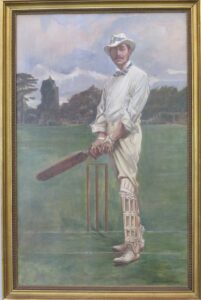
Harris himself was no mean cricketer. He played for England four times and as a right hand batsman was a pillar of Kent’s batting line-up for many seasons, often opening the innings. His highest score was 176, against Sussex at the Bat And Ball Ground, Gravesend, in 1882, a match which Kent won by an innings, and he scored ten other hundreds in a 224 match career which stretched over 41 years. His right arm fast bowling was not overused, but was often effective. He was, uniquely, both captain of Kent and Under-Secretary of State for War between 1886 and 1889, in Lord Salisbury’s Conservative government. He then went off to be Governor of Bombay from 1890, which limited his appearances for Kent but did not stop him remaining on the Kent CCC committee.
A true giant of Kent cricket, Harris’ happiest moment was when Kent finally won the county championship in 1906, a feat he celebrated with dinners, speeches and gifts for all the members of the successful team, and most notably by commissioning the painting ‘Kent v Lancashire 1906’ by Albert Chevallier Tayler, which has rightly come to be considered as masterpiece of cricketing, and indeed all sporting art. Can I throw in a plug for my book, “Stories of Cricket’s Finest Painting, Kent v Lancashire 1906” (Pitch Publishing, 2019)? Still available on line and at all good charity bookshops.
Harris died in 1932, aged 81, at his home, Belmont House near Throwley, where the cricket ground he established is still used every season, and where the family archive is stored. Well worth a visit.